
Trade Events.
Not Just Odds.
Yes or No.
Matchbook Predictions lets you trade on sports, politics and entertainment using simple Yes/No contracts priced as probabilities. UKGC licensed, exchange-powered, and live now with full World Cup 2026 markets.
18+ only. New UK customers. T&Cs apply. Use code WC2026. Bet and settle first £20 on Predictions (max odds 80%). Free bet stake not returned. BeGambleAware.org
World Cup 2026 Offer
Use Bonus Code
WC2026Register and enter code WC2026
Bet and settle your first £20 on any Predictions market
Maximum odds 80% on qualifying bet
Receive your free bets to use on Predictions
Regulation
UKGC Licensed
Commission
2% Net Win
FIFA Partner
PredictStreet
Format
Yes / No Trading
Markets
Sports · Politics · More
Prediction markets have been one of the biggest stories in betting over the past two years. Platforms like Kalshi and Polymarket made headlines in the US during the 2024 election cycle, and the format has grown rapidly since. The basic idea is simple — instead of backing a selection at odds, you buy a Yes or No position on whether something will happen, priced as a probability percentage. It feels closer to trading than traditional betting, and it appeals to a different audience because of that.
The problem for UK punters has always been access. Kalshi operates under US financial regulation and Polymarket runs on crypto with no UK licence. Until recently, there was no regulated way to trade prediction markets from a UK account. That changed in early 2026 when Matchbook launched its own predictions product under the existing UKGC exchange licence — making it the first and currently only fully regulated prediction market available to British customers.
Matchbook prediction markets use the same exchange infrastructure that has powered the platform’s sports betting since 2004. Prices are set by supply and demand rather than by a bookmaker, commission is low, and positions can be bought and sold as sentiment shifts. The product covers sports, politics, entertainment, and current affairs — with the FIFA World Cup 2026 serving as the flagship launch vehicle through a partnership with ADI PredictStreet, FIFA’s official prediction market rightsholder.
This page covers how prediction markets work on Matchbook, what markets are available, how the format compares to traditional exchange betting, and whether the product is worth your time as a UK bettor or trader.
| Detail | Info |
|---|---|
| Product | Matchbook Predictions |
| Launched | January 2026 |
| Licence | UK Gambling Commission (Triplebet Limited) |
| Format | Yes / No contracts priced as probabilities |
| Market categories | Sports, politics, entertainment, current affairs |
| Commission | Standard Matchbook exchange rates |
| World Cup 2026 | PredictStreet partnership — full tournament markets + live streaming |
| Promo code | WC2026 — bet and settle £20, receive free bets |
| Availability | UK, Ireland, international (where permitted) |
What Are Prediction Markets?
A prediction market is a platform where users trade on the outcome of real-world events. Instead of placing a bet at fixed odds set by a bookmaker, you buy a contract that pays out if a specific outcome happens. Each contract is priced between 0 and 100, representing the market’s current estimate of how likely that outcome is. If you think something is more likely than the price suggests, you buy Yes. If you think it is less likely, you buy No.
The price moves in real time based on what other people are doing. If a football team scores and their chances of winning increase, the Yes price rises, and the No price falls — not because an algorithm recalculated, but because traders are buying and selling based on what just happened. It is the same principle that drives stock markets and financial exchanges, applied to events instead of company shares.
Here is a practical example. Say there is a market on “Will England win the World Cup?” priced at Yes 18 / No 82. That 18 means the market collectively believes there is roughly an 18% chance England wins the tournament. If you think England’s chances are better than 18%, you buy Yes at 18. If England wins, your contract settles at 100 and you profit the difference. If they do not, your contract settles at 0 and you lose your stake. The maths is transparent — you always know your maximum risk before you enter a position.
The key difference from traditional betting is that you are not locked in. On a sportsbook, you place a bet and wait for the result. On a prediction market, you can sell your position at any point before settlement. If you bought England Yes at 18 and the price rises to 35 after a strong group stage, you can sell at 35 and take profit without waiting for the final. That ability to trade in and out is what makes Matchbook predictions feel more like a financial market than a betting slip — and it is the main reason the format attracts traders who would never open a Betfair account.
How Matchbook Predictions Works
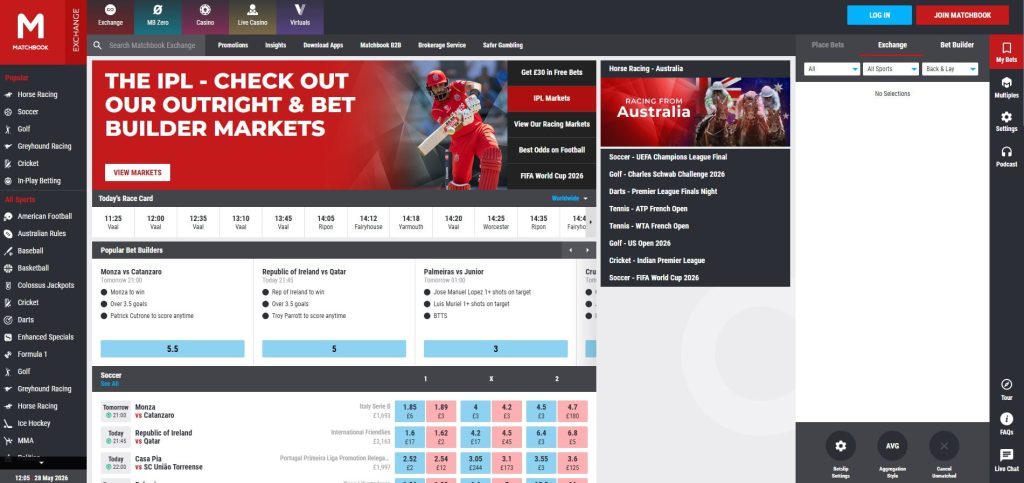
Matchbook Predictions runs on the same exchange engine that has processed sports trades since 2004. The technology is not new or experimental — it is a proven matching system repackaged with a probability-based interface. Your existing Matchbook account gives you access to predictions alongside the exchange, casino, and everything else on the platform. One balance, one login, no separate registration.
The basics
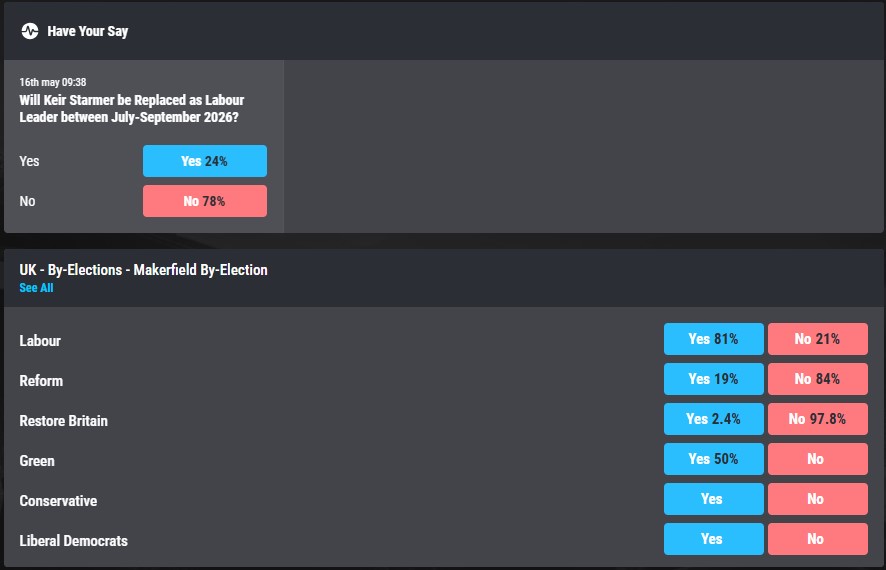
Every market shows a Yes price and a No price, each between 0 and 100. The Yes price is the cost of a contract that pays 100 if the outcome happens. The No price is the cost of a contract that pays 100 if the outcome does not happen. In a liquid market, the two prices add up to close to 100, with the small gap representing the spread — similar to a bid-ask spread on a stock exchange.
When you enter a position, you choose your stake, and the platform matches you against another user on the opposite side. There is no house edge in the traditional sense because Matchbook is not your counterparty. The platform earns revenue through commission on net winnings — the same model as exchange sports betting.
Placing a prediction trade
- Open a market — for example, “Will England win the World Cup?”
- Choose Yes or No based on whether you think the current price undervalues or overvalues the outcome
- Set your stake — the platform shows your maximum risk and potential payout before you confirm
- The exchange matches your order against a user taking the opposite side
- Your position appears in your open trades, updating in real time as the market price moves
Selling before settlement
You are not locked in. If you hold a Yes contract bought at 25 and the price rises to 40, you can sell at 40 by placing an opposing order at the current market price. Your profit is the difference between buy and sell prices, minus commission. You do not need to wait for the event to finish — and that flexibility is the biggest practical advantage over a traditional sportsbook bet.
Settlement and commission
When an event concludes, contracts resolve at either 100 (outcome happened) or 0 (outcome did not happen). The maths is always transparent — if you bought Yes at 30 and it settles at 100, your net profit is 70 minus commission. If it settles at 0, you lose your 30 stake. Maximum risk is known before you enter every position.
Standard Matchbook commission rates apply:
- 2% on net winnings for standard accounts
- 0% for 60 days with code COMMFREE (new customers)
- 0% welcome period also available via WC2026 promo code for predictions-specific signups

Matchbook Prediction Markets: What Can You Trade?
Matchbook Predictions covers four broad categories — sports, politics, entertainment and current affairs. The range is narrower than what you would find on an unregulated platform like Polymarket, where markets can be created on practically anything. That is a direct consequence of operating under UKGC regulation, which imposes limits on what types of events can be offered as betting markets. Within those boundaries, the coverage is solid and growing.
Sports
Sports markets make up the majority of available predictions and benefit from the deepest liquidity. The current flagship is the FIFA World Cup 2026, powered by a partnership with ADI PredictStreet — FIFA’s official prediction market rightsholder. The World Cup hub includes:
- Tournament winner outrights
- Group stage outcomes — which teams qualify, group winners, points totals
- Top scorer markets
- In-play predictions on individual matches
- Live streaming of all 104 tournament matches within the predictions interface
Beyond the World Cup, Matchbook prediction markets cover football leagues, horse racing, golf majors, tennis grand slams, cricket and other sports already available on the main exchange. The difference is purely in how the markets are presented — probability percentages rather than decimal odds — and the ability to trade positions in and out.
Politics
Political betting has always been legal in the UK, unlike the US, where it requires specific CFTC approval. Matchbook offers prediction contracts on UK and international elections, leadership contests and policy outcomes. These markets tend to attract a different user profile — people who follow political news closely and want to back their analysis with money. Liquidity is thinner than on sports markets but often spikes around major events like general elections, US presidential cycles, and referendums.
Entertainment and current affairs
These are the lightest categories in terms of volume, but add breadth to the platform. Entertainment predictions cover awards ceremonies, reality TV outcomes, chart positions and similar cultural events. Current affairs markets can include anything from economic indicators to notable public events, provided the market passes UKGC compliance requirements. Matchbook has indicated it will expand these categories over time, though the pace depends on regulatory comfort and user demand.
What is not available
Matchbook cannot offer the full range of novelty and speculative markets that US platforms like Kalshi list — things like weather contracts, individual company earnings, or crypto price predictions. Those either fall under financial regulation rather than gambling regulation, or sit outside what the Gambling Commission currently permits. If you are looking specifically for financial event contracts, you would need a spread betting broker regulated by the FCA rather than a UKGC-licensed exchange.
Matchbook Predictions vs Traditional Exchange Betting
If you already use the Matchbook exchange, the predictions product might look like a rebrand rather than a new feature. The underlying mechanics are identical — users trade against each other, the platform matches orders and takes commission, and there is no bookmaker setting the prices. The differences are in presentation, market scope and the type of user each format is designed to attract.
The most visible change is the interface. Exchange betting displays prices as decimal odds — 4.0 implies a 25% chance, 1.5 implies roughly 67%. That system is second nature to experienced bettors, but it creates a barrier for anyone coming from a non-betting background. Matchbook Predictions replaces decimal odds with a 0–100 probability scale, which reads more intuitively. A price of 25 means the market estimates a 25% chance. No mental conversion needed.
| Traditional Exchange | Predictions | |
|---|---|---|
| Price format | Decimal odds (e.g. 4.0) | Probability percentage (e.g. 25%) |
| Order types | Back and lay | Buy Yes / Buy No |
| Trading in and out | Yes — lay to close a back, back to close a lay | Yes — sell position at current market price |
| Commission | 2% on net winnings | 2% on net winnings (same rates) |
| Market types | Sports-focused with some politics | Sports, politics, entertainment, current affairs |
| Settlement | Winnings paid at matched odds | Contracts settle at 100 (yes) or 0 (no) |
| Account required | Matchbook account | Same Matchbook account |
| Audience | Experienced bettors and traders | Broader — including non-betting traders |
The practical difference matters most for two groups. Casual users and people coming from a finance or trading background will find the predictions interface easier to read. The percentage format removes the friction of understanding what 3.75 odds actually means in terms of probability — a barrier that has kept exchange betting niche for two decades despite its structural advantages over sportsbooks.
For experienced exchange users, predictions markets expand the range of events you can trade on. Politics, entertainment, and current affairs do not exist on the standard exchange in contract form. The predictions product adds those categories without changing anything about how the platform works under the surface. Your balance, commission tier, and account status carry across both products.
One honest caveat — liquidity on prediction markets is still building. The World Cup 2026 markets are well-supported thanks to the PredictStreet partnership and the sheer volume of interest in the tournament, but smaller political and entertainment markets can be thin. That is normal for any new exchange product and will improve if user adoption continues, but it is worth knowing before you expect the same depth you would find on Premier League football on the main exchange.
Matchbook vs Kalshi vs Polymarket: Which Can UK Users Actually Use?
The prediction market space has grown rapidly since 2024, driven mostly by US platforms. Kalshi and Polymarket dominated the headlines during the American election cycle and between them processed billions in trading volume. The question UK users keep asking is whether they can access those platforms — and the short answer is that Matchbook is currently the only fully regulated option available from a British account.
The three platforms operate under completely different regulatory structures, and that determines everything from who can sign up to how your funds are protected.
| Matchbook Predictions | Kalshi | Polymarket | |
|---|---|---|---|
| Regulated by | UK Gambling Commission | US CFTC (Commodity Futures Trading Commission) | Unregulated — crypto-based |
| UK access | Yes — fully available | No — US residents only | Technically accessible but no UK consumer protection |
| Account funding | Debit card, bank transfer, e-wallets | US bank account, debit card | Cryptocurrency (USDC on Polygon) |
| Fund protection | UKGC requires segregated player funds | CFTC-regulated clearing | No deposit protection or segregation |
| KYC / verification | Full ID verification required | Full US identity verification | Minimal — crypto wallet connection |
| Market range | Sports, politics, entertainment, current affairs | Politics, economics, tech, science, sports, weather | Virtually unlimited — user-created markets |
| Commission model | 2% on net winnings | Per-contract fees | No commission — spread-based |
| Dispute resolution | UK ADR scheme, UKGC complaints process | CFTC oversight | None — smart contract settlement |
Kalshi is a legitimate and well-funded platform, but it is built for the US market. Registration requires a US social security number, and the product is designed around CFTC event contract rules that have no equivalent in UK law. UK residents cannot open accounts. Kalshi’s market range is broader than Matchbook’s — it covers weather, economic data, company earnings and other categories that fall under financial regulation rather than gambling regulation — but none of that is accessible from Britain.
Polymarket is the most open platform in terms of access. It runs on blockchain infrastructure and does not enforce geographic restrictions in the same way. UK users can technically connect a crypto wallet and trade. The problem is that there is zero regulatory protection. No segregated funds, no verified identity checks on counterparties, no complaints process, and no UKGC or FCA oversight. If something goes wrong — a disputed settlement, a platform issue, a lost wallet — there is no regulator to escalate to. For anyone used to the protections that come with UK-licensed betting, that is a significant gap.
Matchbook sits in the middle on market range but leads on regulatory security for UK users. The UKGC licence means segregated player funds, mandatory responsible gambling tools, GamStop integration, and a formal complaints procedure. The trade-off is a narrower set of available markets compared to Polymarket’s anything-goes approach, but for most users, the peace of mind of trading on a regulated platform is worth more than access to a market on whether it will rain in Chicago next Tuesday.
The competitive landscape will change. Kalshi has publicly discussed international expansion and other UK operators are watching the space closely — Flutter’s FanDuel Predicts is already live in the US. For now though, Matchbook prediction markets remain the only product where a UK customer can trade event contracts under full Gambling Commission regulation.
How to Get Started with Matchbook Predictions
If you already have a Matchbook account, predictions are available immediately. The product sits in the main navigation bar alongside the exchange and casino — click Predictions and you are in. No separate registration, no additional verification, no opt-in required. Your existing balance works across all Matchbook products.
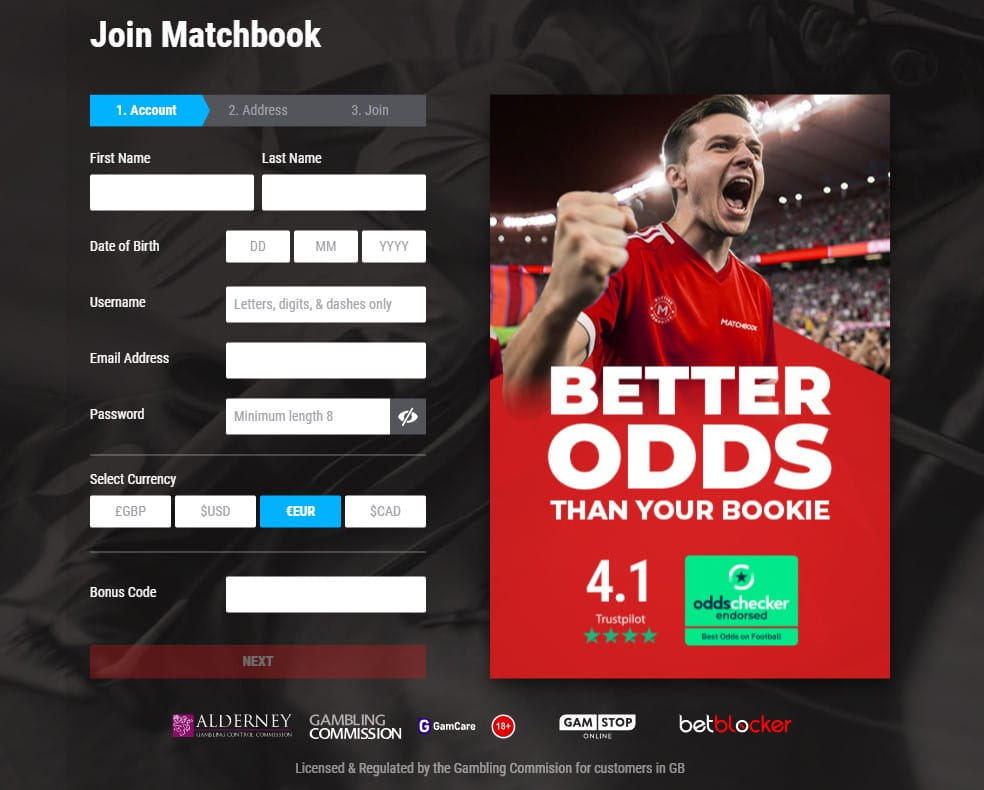
If you are new to Matchbook, the registration process takes a few minutes and follows the standard UK betting account flow:
- Go to Matchbook.com and click Sign Up
- Enter your name, email address, and date of birth
- Create a password and choose your welcome offer — either NEW30 (bet £20 get £30 in free bets) or COMMFREE (0% commission for 60 days)
- Verify your identity — Matchbook will request a photo ID and proof of address as part of standard UKGC requirements
- Deposit a minimum of £10 using debit card or bank transfer (Skrill, Neteller and PaySafe are excluded from welcome offers)
- Navigate to Predictions and start trading
For the World Cup 2026 specifically, Matchbook also offers the WC2026 promo code through the PredictStreet partnership. The offer requires you to bet and settle your first £20 on a predictions market at maximum odds of 80%, after which you receive free bets. If you are signing up primarily for World Cup prediction markets, this code may suit you better than the general exchange welcome offers — though you cannot combine multiple codes on the same account.
Accessing predictions on mobile
The predictions product is available through the Matchbook app on both iOS and Android, as well as through the mobile browser. The interface mirrors the desktop version — same markets, same trading functionality, same account. If you already have the app installed, it will update to include the Predictions tab automatically.
Matchbook Predictions: Pros and Cons
Matchbook Predictions is a genuinely new product category for the UK market, which means it comes with real advantages and real limitations. The strengths are structural — regulated access, low commission, and the ability to trade positions rather than place locked bets. The weaknesses are mostly about maturity — the product launched in early 2026 and the market depth and range are still catching up to the exchange side of the platform.
| Pros | Cons |
|---|---|
| Only UKGC-regulated prediction market currently available to UK users | Market range narrower than unregulated platforms like Polymarket |
| Probability-based pricing is more intuitive than decimal odds for new users | Liquidity is still building outside flagship events like the World Cup |
| Trade in and out of positions before settlement — not locked into a bet | No financial event contracts — weather, earnings, crypto prices not available under UKGC rules |
| Same account, balance and commission rates as the main exchange | Entertainment and current affairs categories are thin compared to sports and politics |
| FIFA World Cup 2026 markets powered by PredictStreet with live streaming | Welcome offer promo codes cannot be combined — you must choose one |
| 2% commission with 0% available for new customers | Interface may feel unfamiliar to users accustomed to traditional odds formats |
| Full UK regulatory protection — segregated funds, GamStop, ADR complaints | Still a new product — features and market depth will evolve over time |
Most of the cons on this list are the kind that resolve with time rather than requiring a fundamental product change. If Matchbook Predictions gains traction — and the World Cup 2026 partnership suggests the company is investing seriously — the liquidity and market range issues will shrink as adoption grows.
Conclusion
Prediction markets are not a gimmick and they are not going away. The US market has proven that the format works — Kalshi and Polymarket between them processed billions in volume during 2024 and 2025, and the audience continues to grow. The question for UK users has never been whether prediction markets are worth using, but whether there is a regulated way to access them. Right now, Matchbook is the answer to that question.
The product is still young. Liquidity outside major events is thin, the market range does not match what unregulated platforms offer, and the format will feel unfamiliar to anyone who has only ever placed bets at traditional odds. None of that is unusual for a first-year product on a new exchange vertical. What matters more is whether the foundations are right — and on that front Matchbook Predictions has the pieces in place. UKGC regulation, a proven exchange engine, low commission, a major FIFA partnership for the World Cup, and the ability to trade in and out of positions rather than waiting for settlement.
For existing Matchbook users, there is no reason not to try it. Predictions sit inside your current account with no extra registration and the same commission structure. For new users arriving specifically because of prediction markets, Matchbook offers a credible regulated platform with a welcome offer that applies across both predictions and the exchange. Whether the product matures into a mainstream UK betting category depends on adoption and liquidity — but as a starting point, it is a genuine product rather than a marketing exercise.
FAQ
What are Matchbook prediction markets?
Matchbook prediction markets let you trade Yes or No contracts on real-world events — sports, politics, entertainment and current affairs. Prices reflect probability percentages set by supply and demand rather than by a bookmaker, and positions can be bought and sold before the event settles.
Are prediction markets legal in the UK?
Yes. Prediction markets operate under gambling regulation in the UK rather than financial regulation. Matchbook Predictions is licensed by the UK Gambling Commission, making it the first and currently only fully regulated prediction market product available to British customers.
Can I use Kalshi or Polymarket from the UK?
Kalshi is restricted to US residents and requires a US social security number. Polymarket is technically accessible via crypto wallet but carries no UK regulatory protection — no segregated funds, no GamStop, no formal complaints process. Matchbook is currently the only UKGC-regulated alternative.
Do I need a separate account for Matchbook Predictions?
No. Predictions are available within your existing Matchbook account alongside the exchange and casino. One balance, one login. If you are a new user, standard registration takes a few minutes and the same welcome offers apply across all products.
What is the PredictStreet World Cup partnership?
ADI PredictStreet is FIFA’s official prediction market rightsholder. Through a partnership with Matchbook, UK and Ireland customers can access a full suite of World Cup 2026 prediction markets — tournament winner, group outcomes, top scorer and in-play predictions — with live streaming of all 104 matches.
What commission does Matchbook charge on predictions?
Standard commission is 2% on net winnings — the same rate as the main exchange. New customers can trade at 0% commission for 60 days using promo code COMMFREE, or claim the WC2026 code for a predictions-specific welcome offer.