
Cheltenham.
Sharper Odds.
Back or Lay.
Matchbook is the UK’s lowest-commission exchange for horse racing. Just 2% on net winnings, no Premium Charge, live streaming on UK and Irish racing, and dedicated Cheltenham offers every March.
18+ only. New UK customers. T&Cs apply. Use code NEW30. First deposit by debit card only. Free bet stake not returned. BeGambleAware.org
New Customer Offer
Use Bonus Code
NEW30Register and enter code NEW30
Settle 1×£10 on the Exchange at odds 2.0+
Settle 1×£10 on a Bet Builder/Multiple at 3.0+
Receive 3×£10 free bets within 72 hours
Regulation
UKGC Licensed
Commission
2% — No Premium Charge
Live Racing
UK & Irish Streams
Cheltenham
Up to £100 Free Bets
App Rating
4.8★ iOS
Cheltenham Festival is the single biggest week on Matchbook’s horse racing calendar — and the week when the exchange’s pricing advantage over traditional bookmakers is most visible. Twenty-eight races across four days, deep liquidity on every championship event, and a commission rate that stays at 2% while Betfair charges 5% as standard and compounds that further through the Premium Charge for profitable accounts. Over a four-day festival where a serious punter might place 30 or 40 bets, that commission gap adds up to real money.
The Matchbook Cheltenham offer for 2026 gave new customers up to £100 in free bets through a combination of qualifying wagers and commission refunds — making it one of the most generous Cheltenham sign-up deals on the market. That specific promotion has now concluded, but Matchbook’s standard welcome offers remain available year-round, and the platform’s horse racing product is worth understanding well before the next festival arrives. This page covers the Cheltenham offers in detail, explains why a betting exchange works differently at a racing festival than a fixed-odds bookmaker, runs through the festival itself for anyone who has not been before, and looks at Matchbook’s racing coverage across the rest of the calendar.
| Detail | Info |
|---|---|
| Platform | Matchbook — peer-to-peer betting exchange |
| Cheltenham offer (2026) | Up to £100 in free bets (code: GET100) |
| Standard welcome offer | Bet £20 get £30 in free bets (code: NEW30) |
| Alternative offer | 0% commission for 110 days (code: COMMFREE110) |
| Commission | 2% on net winnings — no premium charge |
| Horse racing coverage | All UK and Irish meetings — jumps and flat |
| Live streaming | UK and Irish horse racing + greyhounds |
| Exchange markets | Win, Place, Forecast, Reverse Forecast |
| App ratings | iOS 4.8 stars · Android 4.4 stars |
| Licence | UKGC #39504 · Alderney GCC |
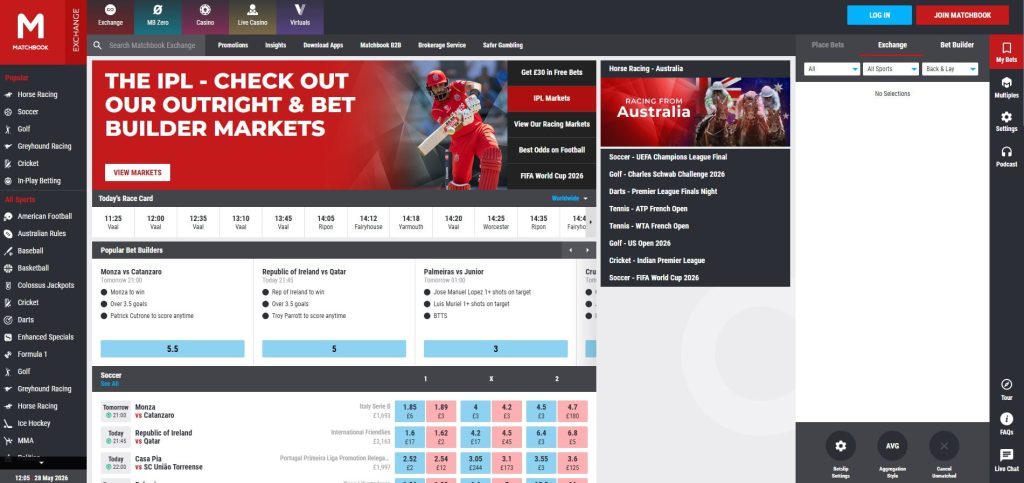
Matchbook Cheltenham Offers Explained
Matchbook runs dedicated Cheltenham promotions every year in the weeks leading up to the festival, and the 2026 editions were among the most competitive in the market. Three separate offers were available — each targeting a different type of punter — plus a commission refund that rewarded exchange activity during the build-up period. All three required a promo code at registration and were restricted to new customers only.
GET100 — Up to £100 in Free Bets
The headline Matchbook Cheltenham offer for 2026 was the GET100 package, which combined a qualifying bet structure with a commission refund to deliver up to £100 in total free bet value.
- Register a new Matchbook account using the code GET100
- Deposit at least £50
- Place and settle 5x £10 bets on five separate horse racing markets at odds of 2.0 or higher
- Once all five bets have settled, Matchbook credits 5x £10 free bets within 48 hours
- Any commission paid on the exchange between registration and 23:59 on March 8 is refunded as additional free bet tokens — up to a further £50
That second component is what pushed the offer ahead of most competitors. A punter who registered a week before the festival, placed their qualifying bets, and then traded actively on ante-post Cheltenham markets could realistically accumulate £30 to £50 in commission refunds on top of the £50 in standard free bets. The refund was automatic — no opt-in required beyond using the GET100 code at sign-up.
MB40 — Bet £20, Get £40 in Free Bets
The MB40 offer ran alongside GET100 and targeted punters who preferred a lower qualifying threshold. The structure was simpler and the entry cost was half.
- Register with the code MB40
- Place and settle 2x £10 bets on two different horse racing markets at odds of 2.0 or higher
- Once settled, receive £40 in free bets within 48 hours — split as 6x £5 horse racing multiples bets and 1x £10 exchange horse racing bet
The split between multiples and exchange free bets is worth noting. Six of the seven free bets were restricted to multiples — accumulators, doubles, trebles — while only one could be used on a straight exchange back or lay bet. For punters who prefer single exchange wagers over multiples, GET100 was the better option despite the higher qualifying requirement.
HR30 — Bet £30, Get £30 in Matchbook Cheltenham free bets
The third option was the simplest. Register with the code HR30, wager £30 on horse racing, and receive £30 in free bets in return. No commission refund component, no multiples restriction — just a clean one-for-one match on racing bets. This offer suited casual bettors who wanted free bet value without committing to the five-bet qualifying structure of GET100.
How the Cheltenham Offers Compared to Competitors
| Bookmaker | Cheltenham Offer (2026) | Qualifying Bet | Free Bet Value | Key Condition |
|---|---|---|---|---|
| Matchbook (GET100) | Bet £50, get up to £100 | 5x £10 at 2.0+ on racing | £50 + up to £50 commission refund | Exchange bets only |
| Matchbook (MB40) | Bet £20, get £40 | 2x £10 at 2.0+ on racing | £40 (6x £5 multiples + 1x £10 exchange) | Multiples-heavy split |
| Betfair | Bet £10, get £50 | 1x £10 at 2.0+ | £50 in free bets | Higher ongoing commission (5%) |
| Betfred | Bet £10, get £40 | 1x £10 | £40 in free bets | Fixed-odds only |
| Sky Bet | Bet 5p, get £40 | 1x 5p | £40 in free bets | Lowest barrier to entry |
| Paddy Power | Various | Varies | Enhanced odds specials | Fixed-odds, money-back specials |
Sky Bet’s 5p qualifying requirement was the lowest barrier in the market, but the ongoing value proposition was weaker — no exchange functionality, no commission advantage, and no ability to lay outcomes. Betfair’s £50 offer required less effort than Matchbook’s GET100, but the 5% commission rate and the Premium Charge for winning accounts eroded the value for anyone who planned to continue betting after the festival. Matchbook’s offers required more upfront commitment but delivered stronger long-term value for punters who intended to use the exchange beyond Cheltenham week.
The Brokerage Service
One feature that most competitors do not offer at any level is Matchbook’s Brokerage Service, which becomes particularly relevant during Cheltenham. The service allows customers to request quotes for large stakes or bespoke bets that may not be available on the exchange. If eligible, the customer is set up with a dedicated channel to one of Matchbook’s brokers, who contacts counterparties to secure the best price and size for the requested wager. For high-volume punters placing four- or five-figure bets on Gold Cup or Champion Hurdle markets, the brokerage route can access liquidity that the standard exchange order book cannot match.
All Cheltenham-specific offers carry a seven-day expiry on free bets once credited. First deposits must be made by debit card or Apple Pay / Google Pay — the Skrill, Neteller and PaySafe card exclusion that applies to the standard welcome offer also applies here. Only one code can be used per customer — you cannot stack GET100 with MB40 or HR30 on the same account.
Why Use a Betting Exchange at Cheltenham
Most punters who bet on Cheltenham do so through fixed-odds bookmakers — Paddy Power, Bet365, William Hill, Sky Bet. They pick a horse, take the price offered, and wait for the result. That model works. It has worked for decades. But it leaves money on the table in ways that become especially visible across a four-day festival with 28 races, deep markets, and constant price movement from Tuesday morning through Friday afternoon.
A betting exchange like Matchbook operates differently. You are not betting against the house — you are betting against other punters. That distinction changes the odds, the flexibility, and the cost structure in ways that matter most when the racing is concentrated, competitive, and liquid.

Better Odds — and Why They Exist
On a fixed-odds bookmaker, the price you see includes the bookmaker’s margin — typically 5% to 15% depending on the market and the operator. The bookmaker sets odds that guarantee a profit across all outcomes regardless of which horse wins. On an exchange, odds are set by the market — by other punters willing to back or lay at a particular price. Because there is no built-in house margin, exchange odds are consistently better than fixed-odds equivalents on the same race. Matchbook offered the best price on 84% of Premier League gameweeks according to Oddschecker’s independent audit — and the same pricing advantage applies to horse racing markets where liquidity is strong.
At Cheltenham, liquidity is as strong as it gets. The Champion Hurdle, Champion Chase and Gold Cup attract exchange volumes that rival top-flight football fixtures, and even the handicap races and novice events carry enough depth to produce meaningful price advantages over fixed odds. Across 28 races, even a marginal improvement in average odds compounds into a measurable difference in total returns.
Back and Lay — Two Sides of Every Race
The most fundamental difference between an exchange and a bookmaker is the ability to lay — to bet against a horse winning. On a fixed-odds site, you can only back. On Matchbook, you can do both.
| Action | What It Means | When to Use It |
|---|---|---|
| Back | Bet on a horse to win (or place) | When you think a horse will win — same as a traditional bet |
| Lay | Bet against a horse winning | When you think a horse is overrated, or to hedge an earlier back bet |
Laying opens up strategies that are simply not available on a fixed-odds platform. If you backed a horse ante-post at 10.0 and the price has shortened to 4.0 by race day, you can lay it at the shorter price and lock in a profit regardless of the result. If you think the Gold Cup favourite is vulnerable but do not know which horse will beat it, you can lay the favourite rather than trying to pick the winner from a 15-runner field. These are not exotic strategies — they are the basic mechanics of exchange betting, and Cheltenham’s deep liquidity makes them practical on every race of the festival.
Trading In-Play
In-play trading takes the back-and-lay principle and applies it during the race itself. Prices on the exchange move in real time as a race unfolds — a horse that is travelling well at the top of the hill sees its price shorten, while a horse that is being scrubbed along sees its price drift. Experienced exchange punters trade those price movements for profit in the same way a stock trader buys and sells during market hours.
Cheltenham is particularly suited to in-play trading because of the course layout. The uphill finish from the final fence to the winning post is the longest climb in National Hunt racing, and it produces dramatic price swings in the final two furlongs. A horse that leads over the last fence at 1.5 can drift to 3.0 or higher if it starts to tire on the climb. A closer travelling strongly can shorten from 6.0 to 2.0 in the space of ten seconds. Those movements create trading windows that do not exist on a flat track with a short run-in.
Matchbook’s app handles in-play racing well — the colour-coded back and lay columns update in real time, and the interface is stripped back enough that you can place a trade without navigating through menus while a race is in progress. Live streaming of UK and Irish racing is available through the app, which means you can watch and trade simultaneously without switching between platforms.
The Commission Advantage Across Four Days
The single biggest financial argument for using Matchbook at Cheltenham is the commission rate. Matchbook charges 2% on net winnings per market. Betfair charges 5% as standard and applies a Premium Charge that can push effective rates to 40–60% for consistently profitable accounts. Over a single bet, the difference is marginal. Over 28 races across four days — with multiple bets per race for active punters — it is not.
A worked example: a punter who turns over £5,000 across the festival and finishes with £500 in net winnings pays £10 in commission on Matchbook. The same outcome on Betfair at the standard rate costs £25. If the punter is subject to the Premium Charge, the Betfair cost could be £100 or more. Over a single festival that gap is noticeable. Over a year of regular racing — Cheltenham, Aintree, Royal Ascot, Goodwood, the daily flat and jumps programme — it represents a structural drag on returns that no amount of better handicapping can overcome.
Matchbook also has no Premium Charge. There is no account restriction for winning customers. If you are profitable on the exchange over time, your commission stays at 2% regardless of how much you win or how consistently you win it. For racing punters who take their form study seriously and expect to show a profit across a meaningful sample of bets, that guarantee is the single most important difference between Matchbook and Betfair.
The Cheltenham Festival — Four Days, 28 Races
The Matchbook Cheltenham offer exists because of what happens in the Cotswolds every March — four days of National Hunt racing that represent the peak of the jump racing calendar in Britain and Ireland. If you have used Matchbook for football or daily racing but have not bet on the festival before, this section covers the structure, the key races, and what to expect from a betting perspective.
The Cheltenham Festival runs from Tuesday to Friday in the second week of March. Seven races are staged each day, with the first race typically jumping at 1:30 pm and the final race at 5:30 pm. The course is a left-handed galloping track with an uphill finish that has produced more drama, more upsets, and more legendary performances than any other venue in jump racing. The climb from the final fence to the winning post is the defining feature — horses that look certain winners at the last obstacle can be caught and passed on the hill, and prices on the exchange reflect that uncertainty right to the line.
Day by Day
| Day | Name | Headline Race | Other Key Races |
|---|---|---|---|
| Tuesday | Champion Day | Champion Hurdle (G1, 2m) | Supreme Novices’ Hurdle, Arkle Challenge Trophy, Mares’ Hurdle |
| Wednesday | Ladies Day | Champion Chase (G1, 2m) | Coral Cup, Cross Country Chase, Champion Bumper |
| Thursday | St Patrick’s Thursday | Stayers’ Hurdle (G1, 3m) | Ryanair Chase, Turners Novices’ Chase, Pertemps Final |
| Friday | Gold Cup Day | Cheltenham Gold Cup (G1, 3m 2f) | Triumph Hurdle, Albert Bartlett, County Hurdle, Martin Pipe |
Each day builds toward the next. Champion Day opens with the Supreme Novices’ Hurdle — traditionally the race that sets the tone for the meeting — and builds toward the Champion Hurdle, where the best two-mile hurdler in training is crowned. Ladies Day centres on the Champion Chase, a speed test over two miles of fences that regularly produces the most visually spectacular racing of the week. St Patrick’s Thursday features the Stayers’ Hurdle and the Ryanair Chase — races that test stamina and tactical intelligence over longer distances. Gold Cup Day closes the festival with its defining race: three miles and two furlongs over fences, the ultimate test of staying power in National Hunt racing.
The Irish Factor
Any discussion of Cheltenham betting in the 2020s is incomplete without acknowledging the dominance of Irish-trained horses — and particularly the Willie Mullins operation based at Closutton in County Carlow. Mullins has been the leading trainer at the festival for six of the last seven years, regularly saddling 50 or more runners across the four days and returning to Ireland with a double-figure haul of winners. In 2024, Irish-trained runners won 19 of the 28 races.
That dominance has a direct impact on exchange markets. Mullins-trained favourites shorten in price as the festival approaches because the weight of money from Irish punters — who follow his form more closely than any British analyst — pushes exchange odds downward in the days before racing. For exchange users, this creates opportunities on both sides. You can back Mullins runners early before the price contracts, or you can lay them on the day at shorter odds if you believe the market has overreacted to the Irish hype. Either way, the exchange gives you the tools to act on an opinion — which is more than a fixed-odds bookmaker can offer when a horse is already trading at its floor price.
Betting Across 28 Races
The sheer volume of racing at Cheltenham creates a different betting environment from a single Saturday afternoon card. Twenty-eight races in four days means an average of one race every 35 minutes during racing hours, and each race carries its own form picture, market profile and exchange dynamics. For punters who bet selectively — two or three races per day — the festival is manageable. For punters who want exposure across the full card, the pace is relentless, and the risk of fatigue-driven mistakes increases through Thursday and Friday.
An exchange account helps manage that volume because of the flexibility it provides. If you backed a horse in the first race and lost, you can lay the favourite in the second race to recover without needing to pick another winner. If you are ahead after Wednesday, you can reduce your stakes on Thursday and Friday to protect profits. If a horse you backed ante-post is withdrawn on the morning of the race, the exchange market adjusts instantly — unlike a fixed-odds bookmaker where you may need to wait for a non-runner announcement and manual void before your money is returned.
The festival rewards preparation, discipline and a clear plan for each day. It punishes impulsive decisions made in the excitement of Champion Day or the desperation of Gold Cup afternoon. Matchbook’s 2% commission means that even if your strike rate is average, you keep more of your returns than you would on any other exchange — and across 28 races, that margin of retention compounds into a material advantage.
Horse Racing on Matchbook Beyond Cheltenham
Cheltenham is the spike, but Matchbook’s horse racing product runs 365 days a year. The exchange covers every UK and Irish meeting — flat and jumps, metropolitan and regional, midweek afternoons and Saturday feature cards. If there is a licensed race meeting happening in Britain or Ireland, there is a market for it on Matchbook. The depth of that market varies — a Tuesday afternoon card at Plumpton will carry thinner liquidity than a Grade 1 at Leopardstown — but the coverage itself is comprehensive.
The Major Festivals
Matchbook Cheltenham is the peak of the jumps calendar, but it is not the only festival where Matchbook’s exchange pricing delivers a measurable advantage over fixed-odds bookmakers. Four other meetings generate deep enough liquidity to make exchange betting practical across the full card.
| Festival | When | Key Races | Exchange Angle |
|---|---|---|---|
| Aintree Grand National Meeting | April (3 days) | Grand National, Aintree Hurdle, Melling Chase | Massive liquidity on the National. 40-runner field makes lay betting particularly valuable — backing a winner is hard, opposing one is easier |
| Royal Ascot | June (5 days, 35 races) | Gold Cup, Queen Anne, Prince of Wales, King Charles III Stakes | Flat racing’s biggest week. Strong exchange volumes on every Group 1. Five days of racing generates similar compound commission savings to Cheltenham |
| Glorious Goodwood | July/August (5 days) | Sussex Stakes, Goodwood Cup, Nassau Stakes | Mid-summer feature meeting. Smaller fields than Ascot but sharp exchange prices on the championship races |
| Christmas/New Year Jumps | December–January | King George VI Chase (Kempton), Leopardstown Christmas Festival | Deep markets on the King George. Irish meetings carry strong cross-channel liquidity |
Between these festivals, the daily racing programme provides consistent exchange activity. The quality peaks on Saturdays — ITV Racing features from Newbury, York, Doncaster and other major tracks draw enough volume to produce competitive exchange markets — but midweek cards at courses like Kempton, Chelmsford and Dundalk also carry tradeable liquidity on most races.
Live Streaming
Matchbook streams UK and Irish horse racing and greyhounds directly through the platform — on both desktop and the app. A funded account with a bet placed in the last 24 hours is the only requirement to access the stream. There is no additional subscription, no paywall, and no need to switch to a separate streaming service while you are trading.
The streaming quality is functional rather than cinematic — it is a data feed designed for punters who need to see the race in real time while managing their positions, not a broadcast-quality production with commentary and analysis. For in-play trading, which depends on watching the race unfold and reacting to price movements as they happen, the integrated stream is more useful than a higher-quality feed on a separate screen because it sits inside the same interface as the exchange order book.
One limitation worth noting: Matchbook does not stream every race on the daily card. Coverage focuses on the higher-profile meetings and may not include the smaller regional fixtures. On festival days — Cheltenham, Ascot, Aintree — streaming coverage is comprehensive. On a quiet Tuesday afternoon, it may be patchy.
Matchbook Zero on Racing
Matchbook Zero is the platform’s commission-free fixed-odds product, available on selected markets across football and horse racing. When a racing market is tagged with the Matchbook Zero label, you can back at fixed odds with zero commission — no 2%, no spread, no hidden cost. The price you see is the price you get, and the full profit is yours if the bet wins.
Zero markets are not available on every race. They appear on selected high-profile meetings and feature races where Matchbook’s trading team has decided to offer commission-free pricing as a competitive tool against fixed-odds bookmakers. During Cheltenham week, Zero markets are more common than during the average midweek card. The same applies to Royal Ascot and Aintree. Between festivals, Zero availability on racing is sporadic — check the app or website on the day rather than assuming it will be there.
For punters who prefer fixed odds over exchange trading but still want access to Matchbook’s pricing, Zero is the bridge. You get bookmaker-style simplicity — pick a horse, take the price, wait for the result — without paying commission on the winnings. The trade-off is that you lose the ability to lay, trade in-play, or set your own odds. Zero is a back-only product.
Daily Racing and the Commission Compound
The commission advantage that matters at Matchbook Cheltenham matters just as much across a year of regular racing. A punter who bets on five races per week — a modest level of activity for anyone who follows the sport seriously — places roughly 260 bets per year. At a conservative estimate of £1,500 in annual net winnings, the commission cost on Matchbook is £30. The same outcome on Betfair at the standard 5% rate costs £75. If the Premium Charge applies, the Betfair cost could be £300 or more.
That annual saving is invisible on any single bet. It only shows up when you step back and look at the year as a whole. Matchbook’s value proposition for horse racing is not about any one race, any one festival, or any one offer. It is about the structural cost advantage that applies every time you win — from a January maiden at Lingfield through to the Gold Cup in March and the King George at Christmas.
Matchbook vs Betfair for Horse Racing
Betfair is the default exchange for most UK horse racing punters. It has been operating since 2000, it dominates exchange liquidity on racing markets, and it is the platform that most people think of when they hear the words “betting exchange.” Any honest assessment of Matchbook for horse racing has to address the Betfair comparison directly — because the question every potential Matchbook customer is really asking is whether it is worth switching from the established market leader.
The answer depends on what kind of racing punter you are.

Commission and the Premium Charge
This is where Matchbook holds its clearest advantage and where the gap between the two platforms is widest.
| Factor | Matchbook | Betfair |
|---|---|---|
| Standard commission | 2% on net winnings | 5% on net winnings |
| Premium Charge | None — does not exist | 20–60% on profitable accounts |
| Discount for volume | COMMFREE110 offer (0% for 110 days for new customers) | Betfair Points system reduces rate to minimum 2% over time |
| Commission on losing bets | None | None |
| Winning account restrictions | None | Premium Charge escalates with sustained profitability |
Betfair’s standard 5% rate is already two and a half times higher than Matchbook’s 2%. But the real divergence occurs when a customer starts winning consistently. Betfair’s Premium Charge identifies accounts that are net profitable over time and applies an additional levy that can push the effective commission rate to 40% or higher — in some reported cases, as high as 60%. There is no opt-out. There is no negotiation. If the algorithm flags your account as consistently profitable, the charge applies automatically.
Matchbook does not have a Premium Charge. It does not have any equivalent mechanism. A customer who wins £10,000 on the exchange in a calendar year pays exactly the same 2% commission as a customer who won £100. For recreational punters who bet occasionally and show a modest profit, the difference between the two platforms is small. For serious form students, professional punters, and high-volume traders who expect to be profitable over a meaningful sample, the difference is potentially thousands of pounds per year — and it is permanent, because the Premium Charge escalates rather than resets.
Best Odds Guaranteed
Betfair offers Best Odds Guaranteed on UK and Irish horse racing through its sportsbook — meaning if you take a price and the starting price is higher, you receive the higher price. This is a sportsbook feature rather than an exchange feature, but it matters because many Betfair customers use both products within the same account.
Matchbook does not offer Best Odds Guaranteed as a standard feature. It has occasionally run BOG as a Cheltenham or Ascot special, but it is not a permanent fixture of the racing product. For punters who routinely back horses early in the day and rely on BOG to protect against price movements, this is a genuine gap in Matchbook’s offering. For exchange purists who trade rather than take fixed positions, BOG is less relevant because the exchange price at the time of the bet is the price — there is no SP comparison.
App and In-Play Experience
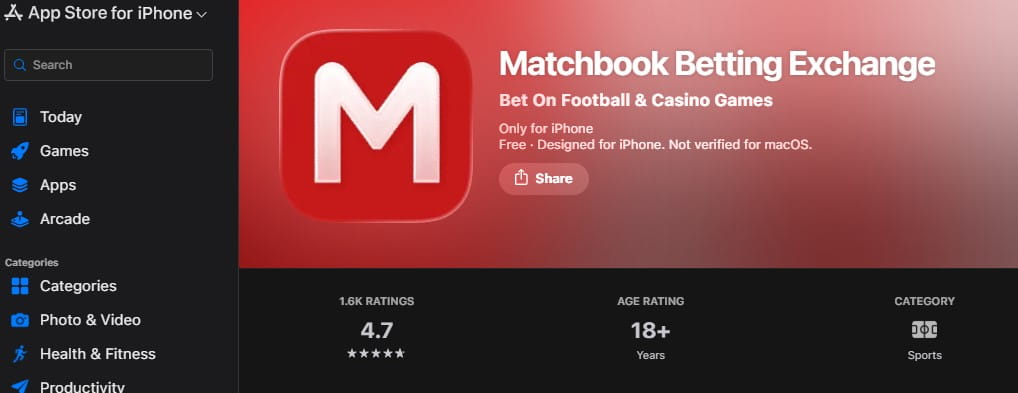
Both platforms offer mobile apps with in-play trading for horse racing. Betfair’s app is older, feature-rich, and occasionally cluttered with cross-sell prompts for the sportsbook, casino and promotions. Matchbook’s app is cleaner, more focused on the exchange product, and rated higher on both the App Store (4.8 vs Betfair’s 4.6) and Google Play (4.4 vs Betfair’s 4.1).
For in-play racing specifically, the app experience matters more than on almost any other sport because the window for trading is measured in seconds. A horse that changes position between the second-last and the last fence at Matchbook Cheltenham can shift in price by several points within the time it takes to unlock your phone, open the app, find the market, and place the trade. Matchbook’s stripped-back interface handles this better than Betfair’s busier layout — fewer taps between opening the app and placing the bet, fewer distractions pulling your eye away from the price columns, and faster load times on the exchange page itself.
Which Exchange for Which Punter
There is no single right answer. The choice depends on how you bet, how often you win, and how much the structural cost of commission matters relative to the depth of liquidity available.
| Punter Type | Better Fit | Why |
|---|---|---|
| Recreational — occasional festival bets, small stakes | Either | Commission difference is marginal at low volumes |
| Regular form student — weekly racing bets, expects modest long-term profit | Matchbook | 2% vs 5% compounds over hundreds of bets per year |
| Professional / high-volume — daily trading, consistently profitable | Matchbook | Premium Charge avoidance is worth thousands annually |
| In-play trader — needs deep liquidity on every race | Betfair | Thicker order book, faster matching on lower-profile races |
| Large-stakes punter — four- and five-figure bets on features | Both — Betfair for liquidity, Matchbook Brokerage for bespoke quotes | Use both accounts for different purposes |
| Matched bettor / arber — needs BOG and promotional offers | Betfair sportsbook | BOG not standard on Matchbook |
Many serious racing punters maintain accounts on both platforms. They use Betfair for liquidity on smaller meetings and in-play trading on low-profile cards, and Matchbook for festival betting and any market where the commission saving outweighs the liquidity difference. That is not a compromise — it is the optimal approach for anyone who treats racing as more than a casual hobby.
FAQ
What is the Matchbook Cheltenham offer?
Matchbook runs dedicated Cheltenham promotions each year for new customers. The 2026 headline offer was GET100 — bet 5x £10 on five separate horse racing markets at odds of 2.0 or higher to receive £50 in free bets, plus any exchange commission paid before March 8 refunded as additional free bet tokens up to a further £50. A lower-threshold option, MB40, gave £40 in free bets for two qualifying £10 bets. Both codes were entered during registration.
Does Matchbook still have a Cheltenham offer available?
The Cheltenham-specific promotions (GET100, MB40, HR30) run in the weeks leading up to the festival each March and are not available outside that window. Between festivals, Matchbook’s standard welcome offers remain active year-round: NEW30 gives £30 in free bets for a £20 qualifying stake, and COMMFREE110 waives the 2% exchange commission for 110 days. Both are entered at registration.
What commission does Matchbook charge on horse racing bets?
Matchbook charges 2% commission on net winnings per market on all exchange bets, including horse racing. There is no premium charge for profitable accounts. By comparison, Betfair charges 5% as standard and applies a Premium Charge of 20–60% on consistently winning accounts. Matchbook Zero offers commission-free fixed odds on selected racing markets.
Can I watch horse racing live on Matchbook?
Yes. Matchbook streams UK and Irish horse racing and greyhounds directly through the platform on both desktop and the app. A funded account with a bet placed in the last 24 hours is required to access the stream. Coverage is comprehensive on festival and feature days but may be patchy on smaller regional meetings.
Can I back and lay on horse racing at Matchbook?
Yes. Matchbook is a betting exchange, which means you can both back a horse to win and lay a horse to lose on any racing market. Laying allows you to bet against a horse winning, hedge earlier positions, or trade in-play as prices move during a race. Exchange markets are available on Win, Place, Forecast and Reverse Forecast outcomes.
What is Matchbook Zero on horse racing?
Matchbook Zero is a commission-free fixed-odds product available on selected horse racing markets. When a race is tagged with the Zero label, you can back at fixed odds with 0% commission — the full profit is yours if the bet wins. Zero markets appear more frequently during major festivals like Cheltenham and Royal Ascot than during midweek cards.
When is the Cheltenham Festival?
The Cheltenham Festival takes place every year in the second week of March, running from Tuesday to Friday. The 2026 edition ran from March 10 to 13. Twenty-eight races are staged across four days — seven per day — with the Gold Cup headlining the final Friday. Matchbook’s Cheltenham-specific promotions typically launch two to three weeks before the festival begins.